GBCSA

Redefine’s Coega logistics facility earns 5-Star Green Star rating

Redefine’s Coega logistics facility earns 5-Star Green Star rating, shifting the performance norm for sustainable industrial development

Redefine Properties’ modern logistics distribution centre at 62 Umlambo Street, located within Zone One of the Coega Special Economic Zone (Coega SEZ), has been awarded a 5-Star Green Star certification by the Green Building Council of South Africa (GBCSA), recognising the property’s high standard of sustainable design and operational performance.

The achievement was formally recognised at a plaque unveiling on Monday, 26 January 2026, attended by representatives from Redefine, Goodyear South Africa (lessee) and the Coega Development Corporation (CDC), the public-sector partner responsible for enabling sustainable development within the Coega SEZ.

Sustainability designed for operational performance

Designed to support large-scale industrial operations in the Eastern Cape, the facility integrates sustainability into its day-to-day performance through energy-efficient systems, water-smart infrastructure and reduced operational carbon intensity. These metrics, measured over time, reflect an efficient deployment of natural resources. This reduces the operational carbon footprint and lowers building operating costs.

Completed in 2010, this property was purpose-built with an emphasis on occupier comfort and enhanced material handling efficiencies. Sixteen years later, it remains a top performer among its peers, demonstrating the successful integration of a well-designed modern logistics facility within the economic ecosystem offered by the Coega SEZ.

“This certification reflects our belief that sustainability must be practical, measurable and embedded in how our assets perform over the long term,” says Ursula Mpakanyane, Head of ESG at Redefine Properties. “High-performing green buildings make commercial sense. They reduce operational risk, improve efficiency, lower long-term costs and create enduring value for both tenants and property owners.”

“We applaud and congratulate Redefine for being certified by the GBCSA as one of the first 5-Star Green Star buildings in a Special Economic Zone. At Coega, we are committed to supporting the Green Star standard set by Redefine and the adoption of environmentally responsible practices to realise a more sustainable and eco-conscious future. Sustainable development is key to our business, and we champion environmental stewardship in our own operations and throughout the Coega SEZ,” Nomathemba Mhlanga, Chief Sustainability Officer, Coega Development Corporation

Creating value through ESG-led development

For tenants, energy- and water-efficient systems contribute to lower operating costs, greater reliability and improved business continuity. For property owners, these efficiencies strengthen asset resilience, support long-term value creation and enhance attractiveness to sustainability-focused occupiers and investors.

Independent research, including insights from the MSCI Global Green Building Index, indicates that Green Star-certified buildings tend to deliver stronger total returns and lower occupancy costs than non-certified assets.

 The certification supports Redefine’s ESG strategy and aligns with the United Nations Sustainable Development Goals, particularly those focused on clean energy, resilient infrastructure, sustainable cities, responsible resource use and climate action. This alignment helps guide capital allocation and asset management decisions in a market where sustainability performance increasingly influences asset value, occupier demand and long-term returns.

For Redefine, the 5-Star Green Star certification at 62 Umlambo Street reflects a deliberate, portfolio-wide commitment to future-ready development that is delivered in partnership with tenants and public-sector stakeholders.

Young talent from university campuses at the Greenovate Awards

Young talent from university campuses across South Africa rise to the challenge of sustainable development at the Greenovate Awards

The 2025 Greenovate Awards marked a decade of student-driven sustainability innovation for the built environment. Created in 2015 by Growthpoint Properties (JSE: GRT) in partnership with the Green Building Council South Africa (GBCSA), the awards continue to recognise the ingenuity of South African university students as they tackle real-world challenges in property and engineering.

Originally conceived to bridge the gap between academia and industry, the awards are now a well-established fixture in the sector, and Greenovate has grown into the country’s leading platform for student sustainability solutions.

This year’s awards saw 29 students from eight universities participate, submitting projects on topics ranging from pee-cycling to the affordability of 3D-printed recycled concrete walls, how greenwashing influences building contractors, and how capital providers for affordable housing view green developments. The winners were announced at a gala dinner held in Sandton.

In the engineering category, the University of Cape Town (UCT) received top honours for a project on the feasibility of producing fertiliser from urine at public event venues such as Cape Town Stadium. The University of Pretoria (UP) claimed second place with a project on using compost to heat water to temperatures needed to ensure safe drinking. UP also took third place with a study showing that partial replacement of cement with fly ash and slag can produce more sustainable concrete without compromising structural integrity or durability.

In the property category, UCT won first place with a project on the financial benefits of certified water efficiency for residential units. UP took second for exploring atmospheric water harvesting as an alternative water supply. UCT also took third with a focus on an optimal model for living walls in the Western Cape.

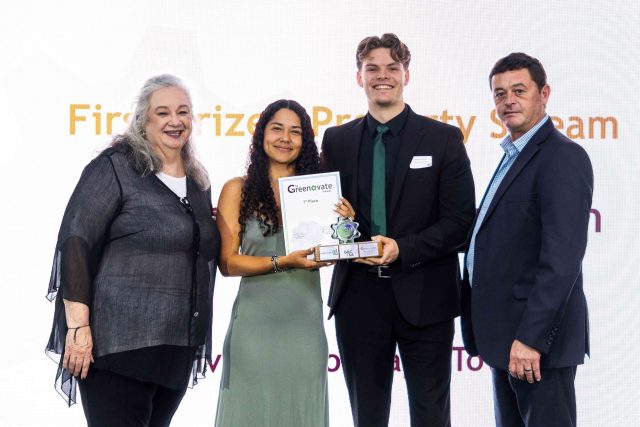
The International Finance Corporation (IFC) Excellence in Design for Greater Efficiency (EDGE) Award was presented to Justine Braaf and Benjamin van Rhyn of UCT for their work on the financial benefits of water efficiency for EDGE residential units in the Western Cape.

To celebrate its tenth anniversary, this year’s awards introduced two new categories focused on implementation potential and alignment with global ESG goals, reflecting the competition’s ongoing evolution and its impact on the future of green building in South Africa.

The Sustainability in Action Award – for the engineering project with the best potential to be implemented within Growthpoint’s portfolio or systems – was awarded to Stellenbosch University’s Hannah Counihan for her project assessing non-stationary extreme rainfall and hydrological design implications in the Western Cape. Judges highlighted the project’s relevance to Growthpoint’s sustainability objectives, ease of implementation and measurable impact.

The Transformative Impact Award recognises the property, quantity surveying or construction project that demonstrates the strongest alignment with the United Nations Sustainable Development Goals and overall ESG performance. It was awarded to Viwe Duma of the University of Johannesburg for exploring investor and funder perceptions of green developments and green certification in the affordable housing sector.

Engelbert Binedell, Chief Operating Officer of Growthpoint Properties, says: “Greenovate has grown to become a platform for real innovation in our sector. Every year we see these students bring fresh ideas and practical thinking to challenges we face today, and every year their solutions are bolder and better suited to put into practice. Reaching the ten-year milestone is a proud moment for Growthpoint. We’re investing in the future of the built environment by backing the people who will shape it.”

 Lisa Reynolds, CEO of GBCSA, says, “GBCSA is immensely proud to be a founding partner of Greenovate, and it’s inspiring to see how the competition has grown from strength to strength over the past decade. Each year, these students remind us of the innovation and optimism shaping the future of our sector. Their solutions tackle real-world challenges head-on and spark sustainability journeys that will play a vital role in South Africa’s green economy.”

 Prizes to advance planet purpose

The top three winners in both categories received a share of nearly R150,000 in prize money. Additional prizes included GBCSA Accredited Professional (AP) Candidate courses and tickets to the annual GBCSA Convention, where top students are invited to present at the Innovation Stage – a career-defining opportunity to showcase their work to business leaders and influencers. The two new awards introduced this year are each worth R10,000 and sponsored by Growthpoint.

All participants benefit from valuable mentorship, networking opportunities and expert-led workshops. They gain access to the knowledge and support needed to translate their research into practical products or services for the property industry. The programme also helps build lasting networks and partnerships among participants.

 Mentorship from market leaders

This year’s mentors for the property stream included Abigail Godsell of GBCSA, Iphendule Ndzipho and Hlologelo Manthose of WSP, Wardah Peters of Solid Green Consulting, Zanengcebo Mthembu of Emira Property Fund, Emash Mohlaba of Eskom, and Sinethemba Ndlovu of Zutari.

Engineering mentors included Alex Varughese of GBCSA, Mary-Anne Fetcher and Sean Moodley of Zutari, Thato Molapo and Wayne de Villiers of Solid Green Consulting, Kutlwano Dikgwatlhe of Johannesburg Water, Claudia Hedley of Metronomic and Siziwe Mulidi of Future Green Now.

Sector leaders at the judging table

The 2025 judges for the property category included Sustainability Specialist Anelisa Keke, Koketso Morakile of Absa, Natasha O’Reilly of Eris Property Group, Tsholofelo Lameck Makgwa of the City of Tshwane, Bakang Moeng of GBCSA, and Kushinga Kambarami of IFC.

Judges for the engineering category included Makhosazana Mthethwa of Solid Green, Craig Blankers of WSP, Mike Aldous of MPAMOT, Dash Coville of GBCSA, Marius Meyer of Growthpoint Properties, and Mischa Tessendorf of Attacq Limited.

 The innovating, planet-shaping 2025 Greenovate Student Awards winners:

 ENGINEERING WINNERS:
1st – Aqeelah Sharief, University of Cape Town: Exploring On-Site Nutrient Recovery and Water Reuse at the Cape Town Stadium

2nd – Georgia Shear, University of Pretoria: Water Sanitation System Through Compost Heating
3rd – Sai’an Dhayaram, University of Pretoria: Performance of Concrete Incorporating High Percentages of Fly Ash and Slag

PROPERTY WINNERS:
1st – Justine Braaf and Benjamin van Rhyn, University of Cape Town: An investigation into the Financial Benefits of Water Efficiency for EDGE Residential Units in the Western Cape
2nd – Michael Walker and Anastacia Phalatse, University of Pretoria: Using Atmospheric Water Harvesting as an Alternative to Traditional Water Supply Methods
3rd – Samuel de Witt and Aiden Pringle, University of Cape Town: Living Walls in the Western Cape: The Optimal Model – A Quantity Surveyor’s Perspective

OTHER PRIZE WINNERS:
• IFC Prize – Justine Braaf and Benjamin van Rhyn, University of Cape Town: An investigation into the Financial Benefits of Water Efficiency for EDGE Residential Units in the Western Cape
• Transformative Impact – Viwe Duma, University of Johannesburg: Perceptions of Investors or Funders of Affordable Housing on Green Developments and Green Certification
• Sustainability in Action – Hannah Counihan, Stellenbosch University: Assessing Non-Stationary Extreme Rainfall and Hydrological Design Implications in the Western Cape

Students from all South African universities are invited to participate in the Greenovate Awards each year and can register at www.greenovatecompetition.co.za/register

Government embraces green building standards

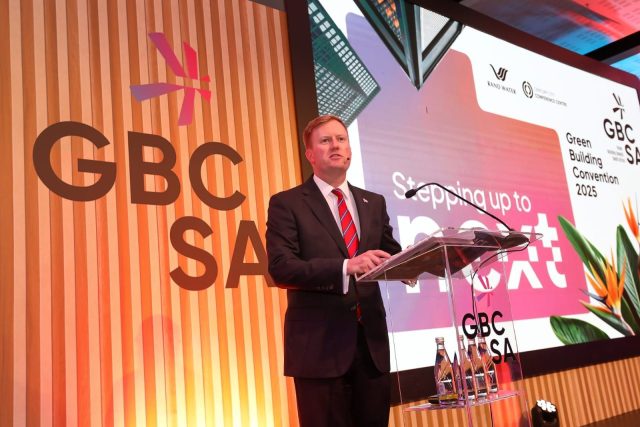
In a landmark announcement at the Green Building Council South Africa (GBCSA) Convention on 11 November 2025, Minister of Public Works and Infrastructure Dean Macpherson outlined an ambitious vision that positions government buildings at the forefront of South Africa’s sustainability transformation.

Leading by example

During his keynote address on the opening day of the convention, Minister Macpherson announced that the Department of Public Works and Infrastructure (DPWI) has formally joined the Green Building Council South Africa as part of its wider reform programme, marking a pivotal shift in how government approaches its role as the country’s largest landlord. This move signals a new era of accountability and leadership in sustainable building practices across thousands of state-owned properties.

“As the largest landlord in South Africa, responsible for thousands of state-owned buildings, we recognise both the burden and the opportunity of our portfolio,” stated Minister Macpherson. “We have a duty to lead by example. Our goal is not only to transform our buildings but also to redefine how we operate as a public institution, by innovating, setting new standards and creating markets that support a sustainable economy.”

The announcement comes at a critical juncture for South Africa’s built environment. With buildings accounting for nearly 40% of global carbon emissions, the minister’s commitment underscores the urgent need to transform how structures are designed, constructed and operated.

Creating markets and economic opportunity

The economic implications of this policy shift are substantial. Minister Macpherson highlighted that the construction sector created 130 000 new jobs in the third quarter of 2025. This represented just over half of all net new jobs created in the quarter. The commitment to pursue 4-star and higher green certifications for new government building projects and precinct developments under DPWI’s control is expected to accelerate job creation while establishing green building as the new standard.

“Imagine how many more could be created if every government building were energy efficient and all new projects met at least a 4-star green rating,” the minister challenged the audience, emphasising that sustainability represents not just an environmental imperative but a powerful economic driver.

Professional development and capacity building

In a move that demonstrates genuine commitment, Minister Macpherson announced that departmental professionals across the property and infrastructure portfolio are being trained as GBCSA accredited green building practitioners. Notably, the minister himself will personally enrol in the GBCSA programme.

“If we want a credible green public sector, we must start with knowledge and accountability,” he emphasised.

From policy to performance: Measurable action

The minister acknowledged that while the 2018 Public Works Green Building Policy laid the foundation, implementation has lagged. Under his leadership, this is set to change with concrete, measurable commitments:

  • A new Property Performance Report will measure space utilisation, efficiency and resource use.
  • An annual State of Public Works Green Building Report will cover energy, water, waste management and socioeconomic impacts, including job creation.
  • The measures announced aim to integrate sustainability into project design from the outset.
  • Existing properties will be certified under GBCSA’s Existing Building Performance programme and prioritised for green upgrades.
  • Solar panels will be installed on suitable government building roofs.
  • Time-of-use meters will be introduced to track and manage water and energy consumption.

“What we don’t measure, we can’t manage,” stated Minister Macpherson.

Implications for the REIT sector

The government’s green building commitment creates significant implications for South Africa’s real estate investment trust (REIT) sector. As government sets new standards, it raises the bar for the entire property industry.

Joanne Solomon, CEO of the SA REIT Association and a GBCSA board member, noted the alignment between this government initiative and the sector’s existing trajectory. “In November 2024, in partnership with Nedbank Corporate and Investment Banking, we launched the SA REIT Sustainability Disclosure Guide aimed at establishing sustainability standards and best practice benchmarks for the real estate sector in South Africa,” Solomon reflected. “Minister Macpherson’s announcement reinforces the critical importance of the sustainability journey our members have undertaken and validates the leadership role that REITs have played in advancing green building practices.”

REITs have already made substantial investments in solar power and water supply infrastructure, continually enhancing their buildings to reduce carbon footprints.

Building South Africa’s sustainable future

Minister Macpherson specifically highlighted partnership with the private sector as essential to unlocking the potential of underutilised government properties. “Many government-owned buildings across cities are vacant or underutilised, missed opportunities that we intend to unlock through redevelopment models that combine green design, social inclusion and economic return,” he stated.

The minister’s vision extends beyond individual buildings to encompass broader economic transformation. “For every 1% of GDP invested in infrastructure, we can unlock up to 1.5% in economic growth, higher still if the infrastructure is green and future-ready,” he noted.

Minister Macpherson acknowledged the GBCSA for its leadership, calling the initiative “not just a technical exercise, it’s a national mission.”

“Together, we can reimagine our buildings not as static structures but as symbols of progress, inclusion and sustainability,” Minister Macpherson concluded. “Let’s build a South Africa that is more sustainable, more resilient and more hopeful. That is how we win.”

The 18th Green Building Convention took place from 11-13 November 2025 at the Century City Conference Centre in Cape Town, under the theme “Stepping up to next”. Macpherson’s address formed part of a wider programme of thought leadership that included Dr Adenike Akinsemolu, founder of The Green Institute and Urban Surfer eco entrepreneur Sifiso Gumbi.

MSCI South Africa Green Annual Property Index 2024

The MSCI South Africa Green Annual Property Index for 2024 continued to reinforce the investment rationale for sustainable, resource-efficient real estate.

Published annually since 2016 in collaboration with the Green Building Council of South Africa (GBCSA) and sponsored by Growthpoint Properties (JSE: GRT), the index offers an independent and globally aligned assessment of how green-certified properties compare to their non-certified counterparts in terms of investment performance.

For 2024, the index showed that green certified Prime & A-grade offices produced a total return of 10.1% which was 120bps above that of non-certified office assets of a similar quality during the year. Since the index’s launch in 2016, green-certified offices have outperformed non-certified assets by a cumulative 28.2%, delivering superior capital growth and operational resilience.

Timothy Irvine, Head of Asset Management: Offices at Growthpoint, which is at the forefront of green-building certification in South Africa, comments, “The 2024 MSCI South Africa Green Annual Property Index reaffirms the investment edge of green-certified commercial real estate. The long-term outperformance of green certified offices signals growing occupier and investor preference for sustainable, resource-efficient real estate and reinforces the strategic competitiveness of portfolios with a strong green building footprint.”

Published in April 2025, the 2024 index covered a sample of 242 prime and A-grade office properties with a combined value of R54.7 billion, including 122 green-certified buildings. Reflecting the growing momentum of green certification beyond the office sector, the index also captured the performance of 33 green-certified retail properties.

“The index has shown over several years that green-certified offices typically have better investment returns than non-certified offices. This year’s expansion to include the retail sector is exciting for us and reflects our commitment to supporting the drive for green across all building typologies. Through this expansion, we’re looking forward to tracking these results, and bringing new insights to market,” says Georgina Smit, Head of Technical, GBCSA 

2024 was another year of outperformance for green certified property

This outperformance of green-certified Prime and A-grade offices was driven by a higher capital growth on the back of a 34% higher gross income per square meter, a significantly lower operating cost to income ratio (39% vs 46%) and a 30bp lower capitalisation rate.

For green certified retail property, the outperformance was similar in 2024. Green certified retail property delivered a total return of 13.2%, 130bps higher than that of non-certified retail with the outperformance driven by an 80bp lower capitalisation rate and a 18% higher net operating income per square meter. Similar to the green office sample, certified retail properties also boasted a lower cost to income ratio of 41% compared to the 44% of its non-certified peers.

Green certified offices also had a lower discount rate, driven in part by a lower vacancy rate (11.1% vs 14.8% for non- Green certified prime and A-grade offices) – reinforcing the premium placed on green office accommodation by occupiers and valuers alike.

Long term outperformance

Since the index’s inception in 2016, prime and A-grade green-certified offices have consistently delivered stronger capital growth than non-certified office properties each year, underscoring the resilience and value proposition of sustainable buildings. Green-certified office assets have outperformed their-noncertified counterparts by a cumulative 28.2%.

While the office sector has led the way in the adoption of green certification, the performance advantage is becoming increasingly evident in the retail segment as well—where a similar return differential emerged in 2024, signalling broader market recognition of the investment benefits of sustainable real estate,

“After nine years of consistent outperformance both on valuations and income, there can be no doubt about the fact that certified properties deliver higher returns to investors. The next step in this journey is to show that certified properties better mitigate Climate Risk and MSCI is well equipped to do that,” says Eileen Andrew from MSCI.

Lisa Reynolds, GBCSA CEO, adds, Our longstanding partnerships around this index are a deep and a solid real investment into providing the property sector with the data and confidence required to build the investment case for green buildings. For some, the question was “Why should I invest in making my property portfolio green?”, now it becomes, ‘Why would I NOT invest in green?’.”

As a leader in sustainable commercial property, Growthpoint holds one of South Africa’s largest and most varied portfolios of green-certified buildings. These assets not only lower the company’s carbon footprint but also support long-term climate resilience central to its ESG strategy. With a clear goal to reach carbon neutrality across its portfolio by 2050, Growthpoint continues to lead in sustainable real estate.

Chief Operating Officer Engelbert Binedell says data from MSCI and the GBCSA is key to shaping Growthpoint’s approach. “We use this data to benchmark performance, refine energy and net-zero targets, and realise the full financial and environmental value of green certification. This data-driven strategy ensures steady progress while meeting the expectations of investors, tenants and society for a low-carbon future.”

Greenovate Awards 2024 celebrate student innovation

Greenovate Awards 2024 celebrate student innovation in sustainability

The 2024 Greenovate Awards have once again highlighted the remarkable ingenuity of South African university students in developing sustainable solutions for the built environment. This annual competition, a partnership between Growthpoint Properties (JSE: GRT) and the Green Building Council of South Africa (GBCSA), challenges students to address real-world obstacles in property and engineering with cutting-edge green thinking.

This year’s awards saw 23 students from eight universities participate, submitting projects that ranged from finding new uses for manganese mining by-products in construction materials to keeping buildings cool inside with biomimicry, the circular economy potential in the construction industry and even making 3D printing more environmentally sustainable. The winners were announced at a gala dinner held at The Galleria in Sandton.

In the engineering category, North-West University received top honours for a project on compact filament production for 3D printing. University of Cape Town (UCT) claimed second place with a project on termite-mound-inspired energy-saving building design, and Stellenbosch University took third with a solution that reduces traffic in the town.

The Property category saw Nelson Mandela University win the top spot with the project on carbon management implementation for quantity surveying professional practice and University of Pretoria took second for exploring the role manganese mining by-products can play in sustainable property development. Two UCT teams took joint took third place with their focus on the impacts of green building certification on different aspects of real estate.

The International Finance Corporation (IFC) Excellence in Design for Greater Efficiency (EDGE) Award was presented to Nosipho Hadebe and Masego Mngomezulu from University of Pretoria for their work on how timber construction in extreme conditions and remote locations impacts indoor air quality.

“In an industry with tremendous power for positive environmental impact that is seeking sustainability solutions, the creativity and passion of these students shines through,” says Engelbert Binedell, Chief Operating Officer of Growthpoint Properties. Greenovate isn’t just an awards programme – it’s a catalyst, introducing top young talent to cutting-edge sustainability concepts and connecting them with industry visionaries. This is more than career development; Greenovate expands South Africa’ green talent pool for Growthpoint, the property sector, the green building movement and country as a whole. The future of sustainable development starts here.”

“The Green Building Council South Africa is consistently proud to partner with Growthpoint in the Greenovate competition and awards. But more than that, we enjoy our participation as mentors and judges and being part of the celebration during the awards event. The students inspire us with their vision, enthusiasm and innovation. Greenovate is indeed a catalyst towards the actualisation of green jobs in an innovative green economy within the built environment,” says Lisa Reynolds CEO, GBCSA.

Prizes to advance planet purpose

The top three winners of both categories received a share of R142,000 in total prize money, and the Greenovate. Additional prizes included EDGE training and certification and tickets to the GBCSA Convention, which includes opportunities to present and showcase winning solutions.

Advantageously, participants get access to valuable mentorship, networking opportunities and expert-led workshops. They gain access to knowledge and resources needed to turn their research into practical products or services for the property industry. This experience fosters lasting networks and partnerships among participants.

Mentorship from market leaders

This year’s mentors for the property stream included Marlene Senne and Abigail Godsell of GBCSA, Iphendule Ndzipho and Hlologelo Manthose of WSP, Wardah Peters of Solid Green Consulting, Mapula Matlakala of African Bank, and Siphesihle Mankahla of EPMO. Engineering stream mentors included Alex Varughese of GBCSA, Mary Anne Fetcher of Zutari, Makhosazana Mthethwa and Thato Molapo of Solid Green Consulting, Tumanga Qholosha of Blackstone Design Consulting, and Kutlwano Dikgwatlhe of Joburg Water.

A panel of change-making judges

The 2024 judges for the property category included Tsholofelo Makgwa of the City of Tshwane, Jennifer Lombard of GBCSA, Kushinga Kambarami of IFC, Adrie Fourie of Solid Green and Brian Unsted of Liberty2Degrees. Judges for the engineering category included Mike Aldous of MPAMOT, Dash Coville of GBCSA, Werner van Antwerpen of Growthpoint Properties, Mischa Tessendorf of Attacq Limited.

The innovating, planet-shaping 2024 Greenovate Student Awards winners:

ENGINEERING WINNERS:

1st – Leon Uys, North-West University: Compact filament production plant for sustainable 3D printing.

2nd – Jacqui Hully, University of Cape Town: Thermal design and analysis of termite-mound-inspired energy saving buildings.

3rd – Sebastiaan Whitward, Stellenbosch University: An optimist’s solution to Stellenbosch’s high influx of commuters.

PROPERTY WINNERS:

1st – Dylan Minaar, Nelson Mandela University: Exploring carbon management implementation for quantity surveying professional practice in South Africa.

2nd – Liam Galloti and Neil Johnston, University of Pretoria: Exploring sustainable housing solutions in Hotazel using mining by-products.

3rd – Oratile Masia and Mihlali Solombela, University of Cape Town: An examination of the impact of green certification on valuation variables and office real estate valuation determination.

3rd – Paige Waberski and Kiah Wallace, University of Cape Town: The investigation into the impact of the Green Star Existing Building Performance (EBP) tool on the office real estate sector in South Africa.

IFC EDGE PRIZE – Nosipho Hadebe Masego Mngomezulu, University of Pretoria: Indoor environmental quality improvement through timber construction in extreme environments and remote locations.

Students from all South African universities are invited to participate in the Greenovate Awards and can register at https://www.greenovatecompetition.co.za/register/